ICRA 2026 Recap
Jun 25, 2026
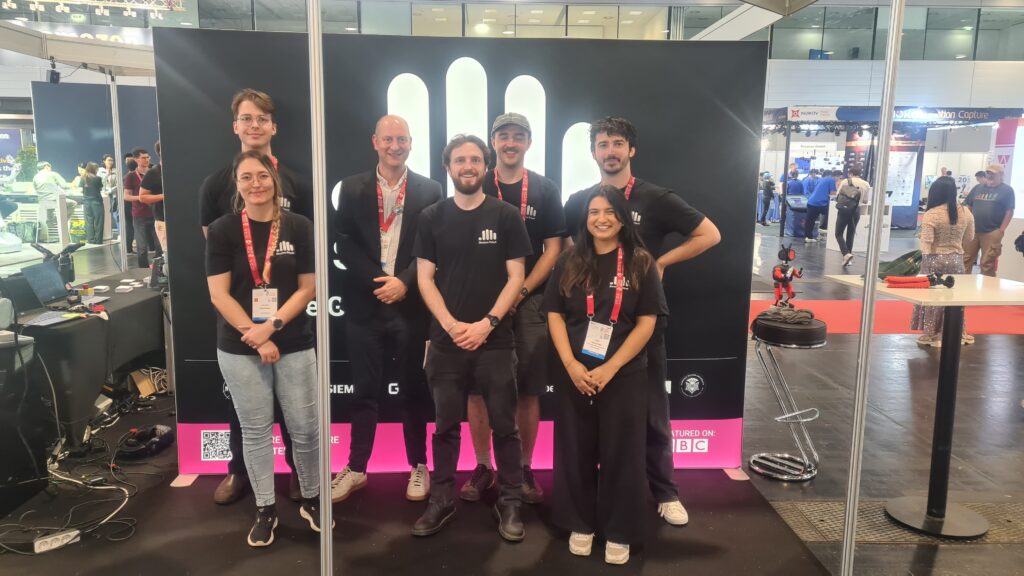
The IEEE International Conference on Robotics and Automation (ICRA) 2026 took place in Vienna this month, bringing together thousands of the world’s leading researchers, engineers, and industry pioneers. Here is our boots-on-the-ground recap of the major trends, standout projects, and key takeaways from Vienna.
ICRA 2026: Robots for All
With nearly 9,000 delegates and 196 exhibitors, ICRA 2026 delivered an inspiring programme of keynote presentations, technical sessions, workshops, competitions, demonstrations, and industry exhibits.
Guided by the theme “Robots for All”, the event showcased how robotics is moving beyond laboratories and into applications that can create meaningful impact across society.
It was fantastic catching up with academics, industry leaders, customers, partners, and collaborators from around the world. Some visitors already knew Shadow Robot and our robotic hands well, while others were seeing them for the very first time. Our stand remained busy throughout the week as visitors explored a range of dexterous manipulation technologies.
What We Brought To ICRA 2026
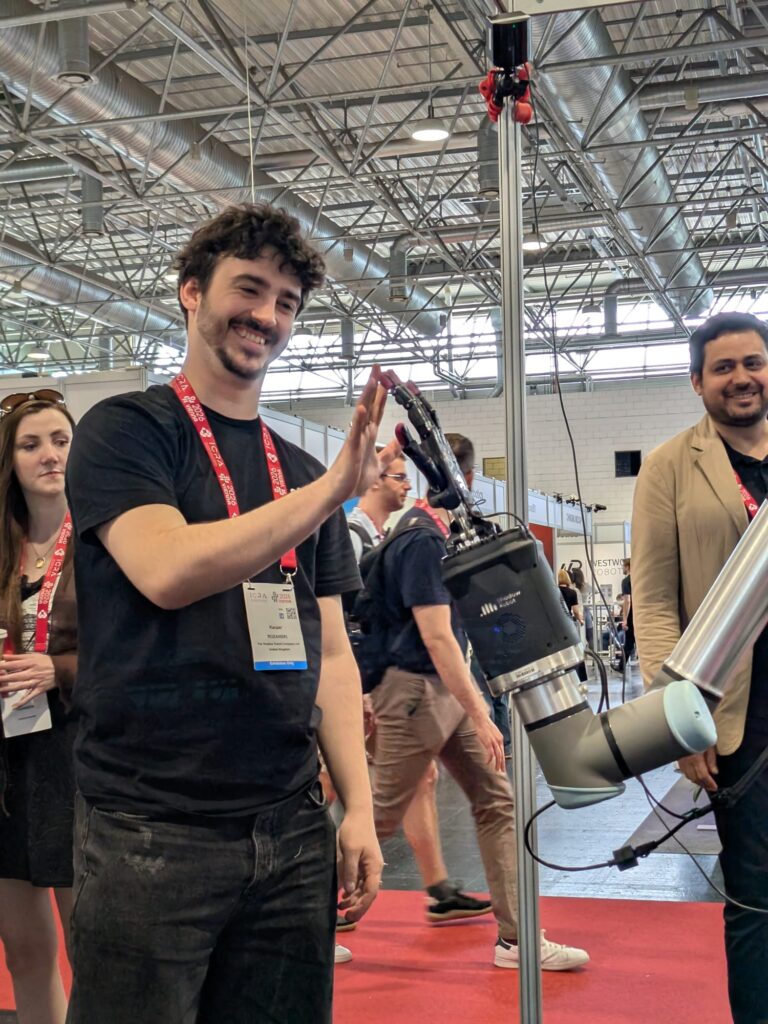
We demoed teleoperation of both our flagship Shadow Hand and DEX-EE CHIRAL robotic hands using MANUS Metagloves Pro Haptic.
DEX-EE CHIRAL
DEX-EE CHIRAL is a three-finger robotic hand with 12 degrees of freedom and a weight of 4.1 kg. Unlike the standard DEX-EE hand, which features a symmetric three-finger configuration, DEX-EE Chiral incorporates a human-like thumb offset. This design enables more natural teleoperation and imitation learning by better aligning robotic hand kinematics with human hand movement. The hand is equipped with multi-taxel magnetic tactile sensors across the distal, middle, and proximal phalanges, providing rich tactile feedback for dexterous manipulation tasks.
DEX-EE CHIRAL hand attracted significant attention as visitors put its durability to the test. More than a few attendees challenged the hand with hammer strikes and impact tests, providing a memorable demonstration of the robustness required for real-world deployment.
Shadow Hand
The Shadow Hand is a five-finger anthropomorphic robotic hand designed to closely replicate human hand movement. It features 24 movements (20 degrees of freedom), weighs 4.3 kg, and is well suited to advanced dexterous manipulation, teleoperation, and robotics research. The hand can be equipped with either Shadow’s proprietary fingertip sensors (Shadow Tactile Sensors) or third-party sensing solutions, providing flexibility for a wide range of research and development applications. Researchers and industry professionals were able to see for themselves how anthropomorphic robotic hands can support advanced grasping, teleoperation, and embodied AI applications where human-like dexterity remains essential.
Teleoperation Through MANUS Gloves
Rather than relying on raw sensor data, our teleoperation system uses the kinematic skeleton and kinematic tree provided directly by the MANUS glove SDK. This delivers precise transforms for each joint, which are then mapped directly to the robotic hands. To ensure an accurate and natural translation of human movement, offsets and scaling parameters were carefully tuned to account for the size and structural differences between human hands and robotic hands. This enables highly responsive and intuitive control of both the Shadow Hand and DEX-EE CHIRAL systems.
One of the most interesting aspects of the demonstration was the dynamic control strategy used to map a five-finger human hand to the three-finger configuration of DEX-EE CHIRAL. The robotic thumb remains continuously mapped to the human thumb. The remaining two robotic fingers adapt dynamically based on the operator’s hand posture.
When the human hand is open:
- Finger 1 (F1) maps to the midpoint between the index and middle fingers.
- Finger 2 (F2) maps to the midpoint between the ring and little fingers.
As the operator transitions towards a pinch grasp, the mapping changes smoothly in real time:
- F1 gradually shifts to align directly with the human index finger.
- F2 gradually shifts to align directly with the human middle finger.
This adaptive approach creates an intuitive control experience while enabling precise manipulation and grasping despite the difference in finger count between the operator and the robotic hand.
Touchlab TACTO: Bringing the Sense of Touch to Robotics
A major highlight of the stand was the integration of Touchlab’s new TACTO tactile sensors into the Shadow Hand. As conversations throughout ICRA repeatedly highlighted, dexterous manipulation requires more than movement alone. Robots must also be able to perceive contact forces and understand how objects interact with their environment.
TACTO combines piezoresistive and capacitive sensing technologies to provide detailed tactile information across the fingertip surface.
Key capabilities include:
- 16 tactile sensing elements (taxels) per sensor
- High-frequency sensing at up to 315 Hz
- Taxel readout rates exceeding 1 kHz for incipient slip detection
- 0–15 N normal force dynamic range per taxel
- Real-time force feedback for manipulation tasks
- Detection of subtle contact changes before object slip occurs
The combination of robust tactile hardware and advanced robotic manipulation creates new opportunities for grasp stability, force control, teleoperation, and embodied AI applications where touch is as important as vision.
Workshop Themes Reinforcing Industry Trends
Several workshops attended throughout ICRA reinforced many of the same themes emerging across the wider robotics community. The workshop Accelerating Discovery in Natural Science Laboratories with AI and Robotics explored how AI, high-throughput experimentation, and laboratory automation are transforming scientific research.
A particularly interesting discussion centred around the challenges preventing wider adoption, including:
- Reliable perception of laboratory equipment and glassware
- Integration with legacy, non-digital instruments
- Safe deployment of robotic manipulators in shared environments
- Lack of standardisation across laboratory systems
These challenges closely mirror many of the real-world deployment issues faced across industrial robotics more broadly.
Another standout workshop explored the future of embodied telepresence through robotics. The discussions examined how advances in telerobotics, haptics, shared autonomy, multimodal interfaces, and AI could move remote interaction beyond video conferencing towards true embodied presence.
As teleoperation systems become more sophisticated, dexterous robotic hands will play a critical role in enabling meaningful physical interaction at a distance.
ARIA Collaboration
It was also fantastic spending time with our Advanced Research + Invention Agency (ARIA) partners and collaborators. Across multiple projects, we saw exciting examples of how robotics, AI, sensing, and manipulation technologies are being combined to tackle ambitious challenges. The creativity and pace of innovation on display demonstrated why collaborative research remains such an important driver of progress in robotics.
Inspiring the Next Generation
One of the most enjoyable parts of the week was seeing the next generation of roboticists. From babies in strollers to young children fascinated by the demonstrations, it was a reminder that robotics continues to capture imaginations across all ages.
Events like ICRA are not only about showcasing the latest technology. They are also about inspiring the people who will build the next generation of robotic systems.
Looking Ahead
ICRA 2026 reinforced a belief we have held for many years at Shadow Robot: dexterous manipulation remains one of the most important challenges in robotics. As embodied AI, teleoperation, tactile sensing, and physical intelligence continue to advance, robotic hands will become increasingly important interfaces between intelligent systems and the physical world.
We’re excited to continue working with researchers, customers, partners, and collaborators to help shape that future.
Thank you to everyone who stopped by our stand, tested our robots, shared ideas, and contributed to the conversations that made ICRA 2026 such memorable experiences.
We look forward to seeing you again soon. Until then, watch our ICRA 2026 recap video here!